What is BitVM? The protocol that enables Layer 2 rollups on Bitcoin

BitVM enables complex smart contracts on Bitcoin without changing its rules
Introduced in 2023 by Robin Linus, BitVM (short for “Bit Virtual Machine”) proposes a new paradigm: enabling complex computations on Bitcoin without modifying its consensus rules.
The core idea is simple: instead of executing computations directly on-chain, they are performed off-chain and only verified if necessary through a proof mechanism.
In this model, one participant, the “prover”, claims that a computation is correct, while another, the “verifier”, can challenge that claim. This interaction relies on a “challenge-response” protocol, similar to the one used in optimistic rollups on Ethereum.
In practice, if the verifier suspects fraud, they can initiate a sequence of challenges that forces the prover to reveal parts of the computation step by step. If an inconsistency is found, it can be proven on Bitcoin using scripts, without executing the full computation on-chain.
This system relies on existing Bitcoin primitives, including:
- hashlocks
- timelocks
- Taproot trees, which allow more complex script structures
Thanks to this architecture, BitVM makes it theoretically possible to express “Turing-complete” contracts on Bitcoin, meaning contracts capable of handling a wide range of computations, without altering the protocol.
More importantly, BitVM opens the door to a new category of infrastructure: Layer 2 systems.
By allowing off-chain computation with on-chain verification, BitVM can serve as a foundation for building rollups on Bitcoin, where transactions are executed off-chain and secured by the base layer.
Toward Bitcoin rollups, but still with important limitations
One of BitVM’s main contributions is bringing Bitcoin closer to the rollup model already widely used on Ethereum. In this model, transactions are processed off-chain, aggregated, and then verified on the base layer, improving scalability without sacrificing security.
However, BitVM remains, for now, largely a theoretical construction with several limitations.
In its initial design, the protocol relied on a limited set of participants capable of initiating fraud challenges. This created a dependency on specific actors to ensure the system’s integrity.
This is one of the aspects improved in BitVM2, an evolution of the protocol that introduces permissionless challenging, allowing anyone to dispute a suspicious transaction.
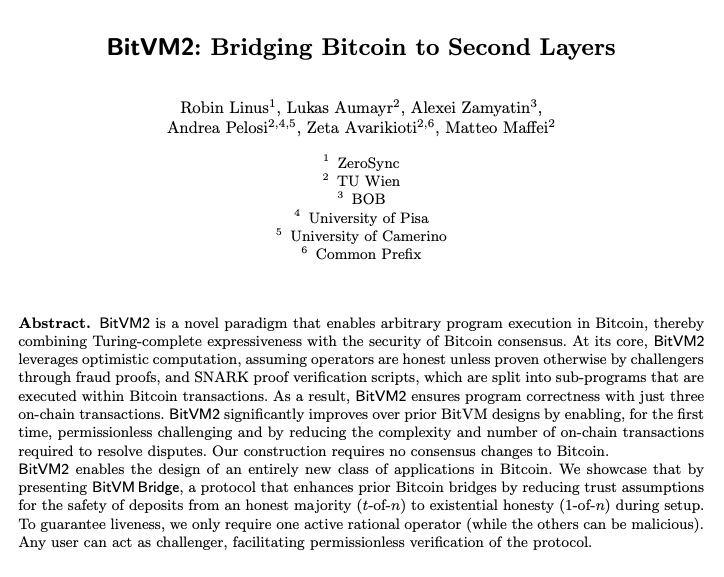
Another key improvement is the drastic reduction in verification cost. While the original BitVM required dozens of transactions to prove fraud, BitVM2 reduces this process to just a few transactions, making it significantly more efficient and practical.
Despite these advancements, several challenges remain.
BitVM relies on interactive challenge processes between participants, which introduce delays due to time-based dispute mechanisms. This latency can limit certain use cases, especially those requiring fast finality.
Additionally, Bitcoin’s script size limitations still constrain the complexity of computations that can be verified on-chain. While upgrades like Taproot have expanded these capabilities, they remain more restrictive than environments designed specifically for smart contracts.
⚡️ What is the Lightning Network? The ultra scalable Bitcoin layer
Finally, as with all Layer 2 solutions on Bitcoin, user experience remains a critical challenge. While the model is theoretically robust, integrating it into seamless, user-friendly applications is still an open problem.
BitVM does not turn Bitcoin into a programmable blockchain in the traditional sense. Instead, it introduces a new way to leverage Bitcoin’s existing properties to extend its capabilities.
It is still too early to determine whether fully functional rollups will be deployed at scale on Bitcoin. But one thing is already clear: BitVM represents one of the most credible approaches to building advanced Layer 2 systems without changing Bitcoin’s fundamental rules.