What is RGB, the ultra-scalable and highly confidential Bitcoin Layer 2?

RGB relies on client-side validation to extend Bitcoin’s capabilities
Unlike a traditional blockchain, RGB does not rely on a global consensus where every transaction is validated by the entire network. Instead, it is built around a concept known as client-side validation, which fundamentally changes how transactions are processed.
In this model, only the parties involved in a transaction verify its validity. When a user receives an RGB asset, they must also receive the associated cryptographic history, known as the “stash,” which allows them to verify that the asset is valid from its origin. The Bitcoin network itself only acts as an anchoring layer, not as an execution layer.
⚡️ What is the Lightning Network? The ultra scalable Bitcoin layer
This architecture relies on a mechanism called the “single-use seal,” originally proposed by Peter Todd. Each RGB state is linked to a Bitcoin UTXO, which acts as a cryptographic seal. Once used, this seal cannot be reused, ensuring that an asset cannot be spent twice.
In practice, RGB transactions are not recorded on the Bitcoin blockchain. Only a cryptographic proof, known as a “commitment,” is anchored on-chain, while all transactional data remains off-chain between users.
This design enables two key properties.
First, extremely high theoretical scalability: thousands, potentially millions, of transactions can be compressed into a single Bitcoin transaction. Second, enhanced privacy: unlike Bitcoin or Ethereum, no transaction data is publicly visible.
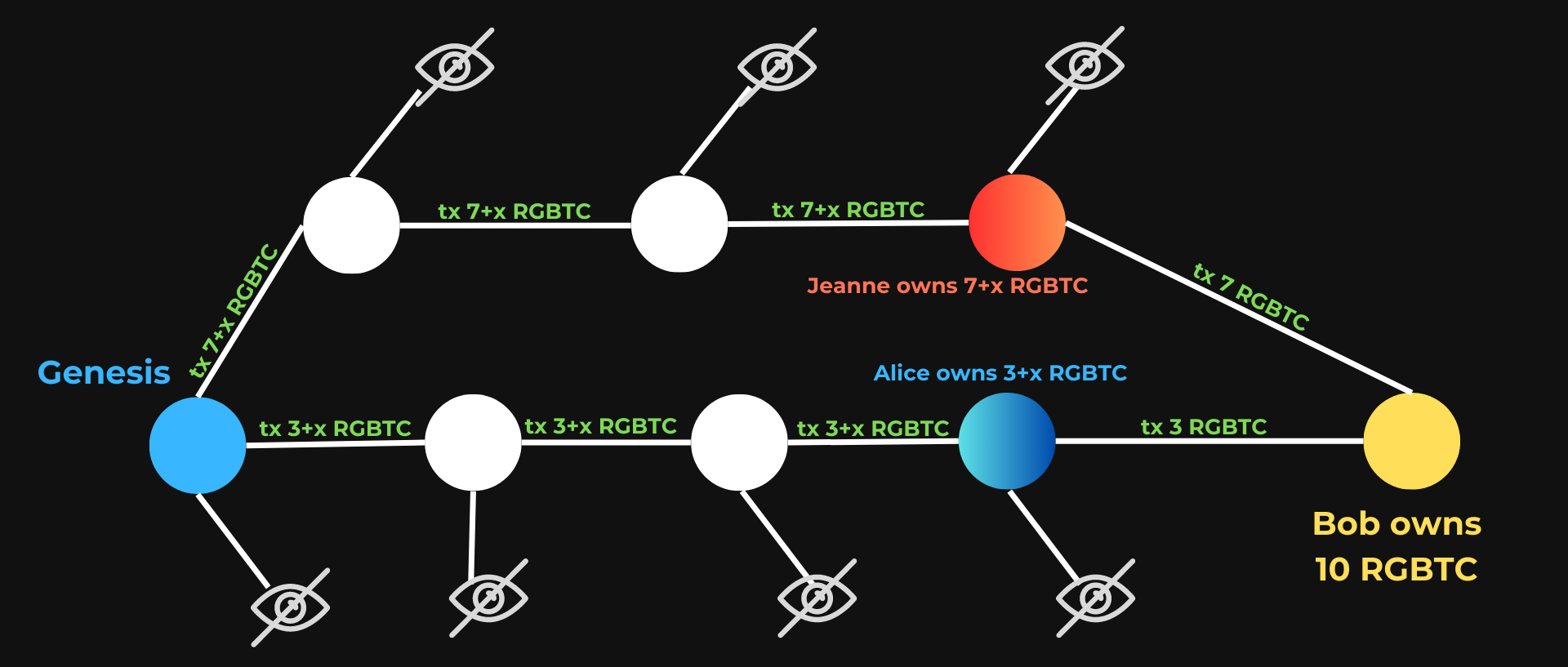
RGB therefore allows the creation of complex assets and contracts, including fungible tokens, NFTs, digital identities, and financial applications, without overloading the blockchain. Each contract follows a set of rules defined in a “schema,” which determines how assets can be issued, transferred, or destroyed.
However, this approach comes with a direct consequence: responsibility is shifted to the user. Users must store their own data and verify their own assets. In practice, this introduces significant challenges related to storage, data availability, synchronization, and overall user experience.
A split between RGB 0.11.1 and 0.12, balancing protocol purity and usability
The development of RGB has recently diverged into two distinct versions, reflecting different approaches to the protocol.
Version 0.11.1 represents the current implementation closest to the original design. It strictly follows the client-side validation model, with no reliance on external infrastructure. This approach maximizes decentralization and privacy, but remains difficult to use in practice. Data management, transfer of information between users, and overall complexity continue to limit adoption.
In response to these limitations, a major redesign was introduced with RGB 0.12. This version aims to simplify the architecture, standardize components, and improve the developer experience. It introduces clearer contract structures, reduces consensus complexity, and prepares the protocol for more advanced features, such as integration with zero-knowledge proofs.
This evolution does not fundamentally alter RGB’s core principles, but it shifts the balance between theoretical purity and practical usability. While version 0.11.1 prioritizes strict decentralization, version 0.12 focuses on making the protocol more viable at scale.
This split reflects a broader tension within the Bitcoin ecosystem. The solutions that are most aligned with Bitcoin’s original principles are often the hardest to use, while more accessible approaches tend to introduce new layers of abstraction or infrastructure.
RGB remains a protocol in transition. Its theoretical potential is widely recognized, particularly in terms of scalability and privacy. However, its adoption will ultimately depend on its ability to solve a more practical problem: turning an elegant technical model into a system that is actually usable.
It is still too early to determine which version will prevail. What is already clear, however, is that RGB represents one of the most advanced attempts to extend Bitcoin without altering its foundations, at the cost of a complexity that remains, for now, difficult to abstract away.