What is Citrea? The Bitcoin rollup powered by BitVM?

Citrea, a Bitcoin rollup designed to unlock BTC in DeFi
Over the past few years, multiple attempts have been made to extend Bitcoin’s capabilities, with a recurring objective: enabling financial applications without compromising the security of the base layer. Between sidechains, payment solutions, and experimental protocols, no single approach has yet become dominant.
Citrea fits into this broader trend by adopting a rollup architecture, inspired by what already exists on Ethereum. The principle is straightforward: transaction execution happens off-chain, while security and final settlement remain anchored to Bitcoin.
In this model, transactions are aggregated and validated using cryptographic proofs, known as zero-knowledge proofs (ZK proofs), before being published on Bitcoin. This approach increases scalability while preserving the security guarantees of the network.
Another core component of Citrea is its integration of BitVM, a theoretical computation model that allows complex operations to be verified on Bitcoin without requiring protocol changes. In practice, BitVM enables more advanced verification mechanisms, particularly for cross-layer interactions.
Citrea’s infrastructure relies on several building blocks:
- an EVM-compatible execution environment, simplifying application development
- a bridge system, allowing BTC to be transferred into the rollup as a represented asset
- financial applications, such as lending platforms and decentralized exchanges
The stated objective is clear: allow Bitcoin holders to use their capital within financial applications without leaving the Bitcoin ecosystem.
From a technical standpoint, the approach is coherent. It aligns with a broader trend aiming to transform Bitcoin from a passive asset into an active financial infrastructure.
However, this vision comes with a more controversial shift.
The launch of the CTR token, a pivot that weakens Citrea’s credibility
One of Citrea’s initial positioning strengths was a simple promise: build on Bitcoin without introducing a new token.
In an ecosystem saturated with Layer 2 tokens, this approach strengthened the project’s credibility, aligning it with a more Bitcoin-native philosophy.
The launch of the CTR token marks a clear departure from that stance.
Presented as a coordination asset, CTR enables users to participate in protocol governance through a vote-escrow mechanism. By locking tokens into xCTR, users can influence how incentives are distributed, particularly in terms of liquidity allocation across applications.
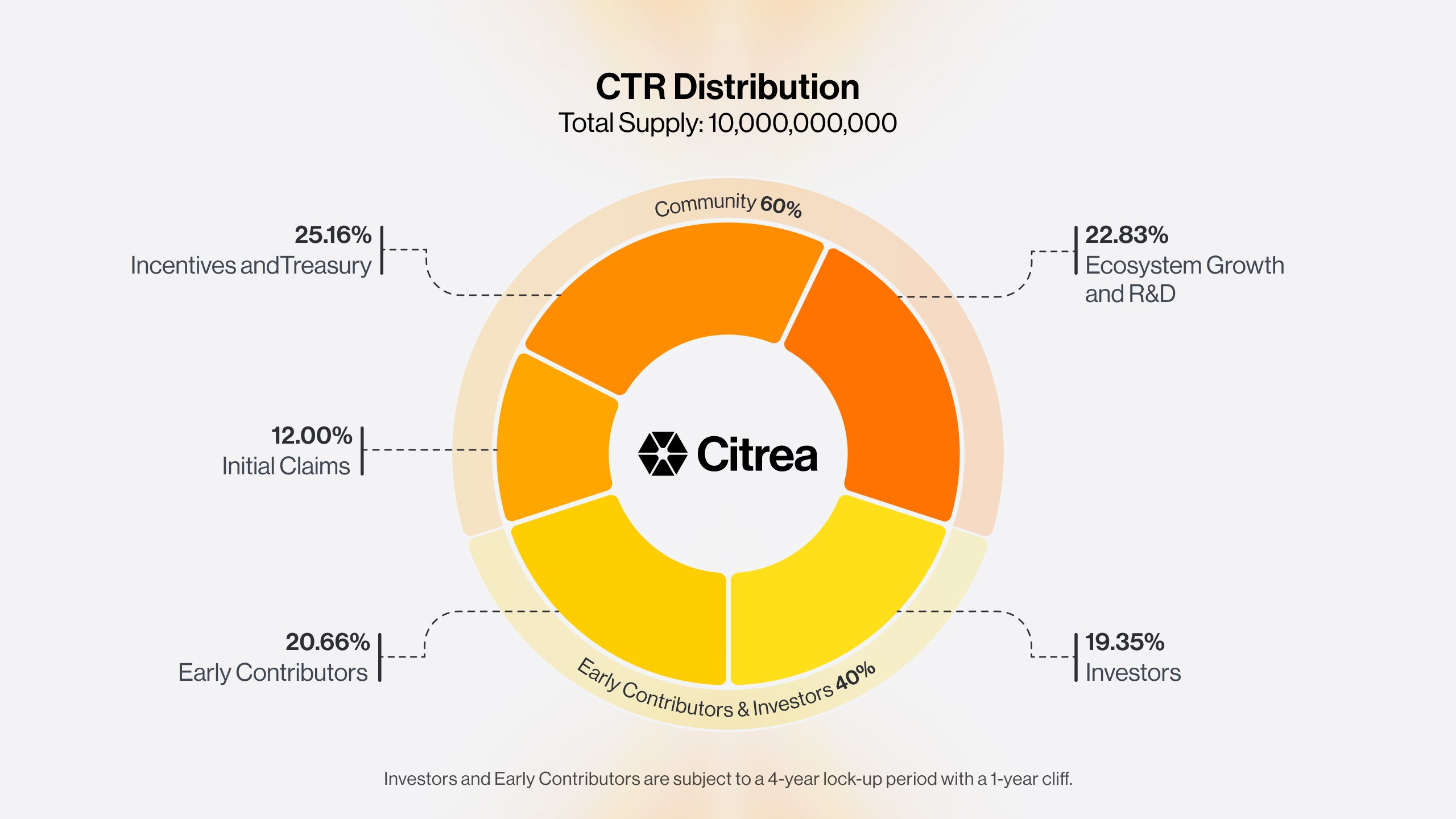
This model, widely inspired by existing DeFi protocols, introduces an additional layer of economic complexity. It relies on incentive structures, voting systems, and capital allocation mechanisms that move away from the simplicity initially emphasized.
More importantly, it reintroduces a familiar dynamic: a token designed to capture and redistribute value.
This raises several issues.
First, it creates a parallel economy alongside BTC, despite Citrea positioning itself as an extension of Bitcoin. Second, it exposes the protocol to speculative dynamics linked to the valuation and usage of this new asset.
This pivot can be seen as a weakening of Citrea’s original positioning. The absence of a token was a key differentiator, bringing it closer to the principles valued by part of the Bitcoin ecosystem.
⚡️ What is the Lightning Network? The ultra scalable Bitcoin layer
By introducing CTR, Citrea ultimately adopts a model closer to traditional DeFi architectures, at the risk of diluting its initial value proposition.
Whether this decision will accelerate adoption or blur the project’s positioning remains to be seen.
In an ecosystem still in an experimental phase, the outcome is uncertain. But one thing is already clear: maintaining a truly Bitcoin-native approach while introducing economic coordination layers remains a difficult balance to strike.