What is Rootstock? The Bitcoin sidechain for smart contracts

Rootstock, a sidechain adding a programmability layer to Bitcoin
Since its launch in 2009, Bitcoin has relied on a deliberately limited architecture: a simple scripting language, designed to prioritize security and robustness over flexibility. This structural constraint explains why, unlike other blockchains, Bitcoin was not built to support complex applications or decentralized finance protocols.
This is precisely where Rootstock positions itself. Rather than modifying Bitcoin, the protocol introduces a parallel blockchain connected to it, enabling the execution of smart contracts. This architecture is known as a “sidechain.”
In practice, Rootstock operates through a “peg” mechanism: users lock BTC on the main blockchain, which is then represented as rBTC on the sidechain. This rBTC, pegged 1:1 to bitcoin, acts as the primary asset for interacting with applications on the network.
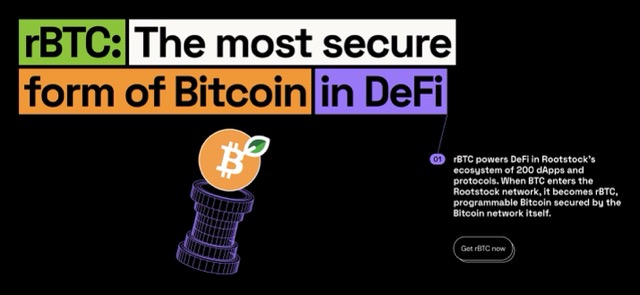
One of Rootstock’s core components is merged mining. This mechanism allows Bitcoin miners to secure the Rootstock network simultaneously, without additional effort, using the same hashing power. The goal is to align the sidechain’s security as closely as possible with Bitcoin’s, without creating a fully independent system.
From a technical standpoint, Rootstock also stands out due to its compatibility with Ethereum’s Virtual Machine (EVM). This means developers can deploy smart contracts written in Solidity without learning a new environment. As a result, existing applications, particularly in DeFi, can be ported more easily.
Finally, transfers between Bitcoin and Rootstock rely on a mechanism called PowPeg, a bridge that locks and releases funds across both networks. This component is critical, as it directly impacts both usability and trust assumptions.
⚡️ What is the Lightning Network? The ultra scalable Bitcoin layer
Expanding Bitcoin’s use cases, but with structural trade-offs
By enabling smart contracts on Bitcoin, Rootstock opens the door to new use cases: decentralized lending, BTC-backed stablecoins, trading platforms, and programmable financial applications. The objective is clear: turn Bitcoin into a foundation for “BTCFi,” without relying on external blockchains.
This approach addresses a real demand. Some users want to do more with their bitcoin than simply hold or transfer it, integrating it into more complex financial systems.
However, this expanded functionality comes with trade-offs.
The first concerns the security model. Unlike Bitcoin, where transactions are validated directly by the network through Proof of Work, Rootstock relies on a separate infrastructure. While merged mining strengthens its security, transaction validation and smart contract execution remain external to Bitcoin’s base layer.
The second trade-off involves the bridge. Once users convert BTC into rBTC, they depend on the transfer mechanism between the two chains. This introduces an additional layer of risk that does not exist when holding native BTC. Historically, bridges have been among the most vulnerable components in the crypto ecosystem.
Finally, the introduction of smart contracts brings a new category of risks tied to the applications themselves: bugs, exploits, liquidations, or protocol failures. These risks are well known in Ethereum’s ecosystem but are absent from Bitcoin’s traditional usage.
Rootstock follows a clear logic: adding utility to Bitcoin at the cost of increased complexity.
It is still too early to determine whether this type of infrastructure will become a standard within the Bitcoin ecosystem. One thing is certain: Rootstock is not trying to replace Bitcoin, but to expand what can be built on top of it.
Between the simplicity of the base layer and the programmability of secondary layers, it is ultimately the market that will decide where the balance lies.