
Bull Bitcoin accepted MiCA, but refuses to say yes to everything
By arriving in Europe through the acquisition of Leonod, BULL BITCOIN had to enter an already heavily regulated environment, with the AMF, MiCA, compliance obligations and all the discussions that now accompany the activity of regulated platforms.
Today, Bull Bitcoin is publicly revealing a procedure that has already been underway for several months. It is taking the matter to the Conseil d’État to have the French decree transposing DAC8 canceled, the European directive that organizes the automatic collection and transmission of identity and transaction data from crypto platform users.
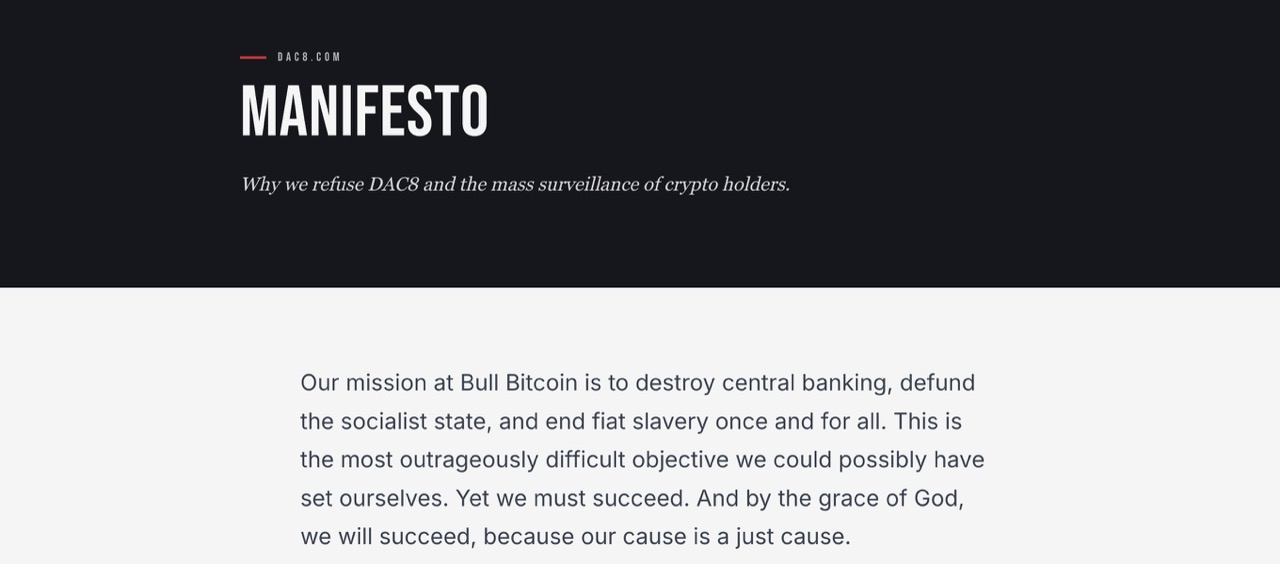
At the same time, the company launched dac8.com, a website designed as a public dossier against the text, with its arguments, figures, sources and political reading of what Bull Bitcoin describes as a shift toward mass surveillance of Bitcoin holders.
It is in this precise context that I spoke with Théo Mogenet, Managing Director of Bull Bitcoin Europe, to understand why a company that has just obtained MiCA would decide, almost at the same time, to attack DAC8.
The company is not speaking from the margins, nor from an anti-regulation stance on principle. On the contrary, it has just spent several months obtaining its MiCA authorization, with everything that implies in legal costs, audits, regulatory capital and management time spent on compliance tasks rather than product development.
In his account, MiCA therefore remains a demanding framework, sometimes heavy, but still understandable in its logic. The point is to enter the European market, operate legally there and accept the common rules that come with this regulatory passport. The problem begins when this logic no longer sets a clear limit to the regulator’s appetite. Théo Mogenet sums up this tipping point with a formula that is set to become central in this case:
“If you start saying yes to everything, there is no longer any limit. You therefore send them the signal that they can make any request, however capricious it may be, and that you will systematically comply with it, without ever questioning whether it is justified.”
Today, the company is not attacking DAC8 to say that no rule is legitimate. On the contrary, it says that after having accepted MiCA, it is now in a position to refuse what it considers to be one step too far. The message to the sector is clear. Being regulated should not mean giving up any capacity for resistance.
🪙 Is Bitcoin (BTC) Really a Currency?
DAC8 would not only be one more tax constraint, but a systemic risk for users
The heart of Bull Bitcoin’s argument rests on the idea that DAC8 changes the very nature of crypto regulation in Europe. Since January 1, 2026, European Directive 2023/2226 has required crypto-asset service providers to collect and then transmit identity and transaction data concerning their users to their local tax authority. Presented from Brussels as a tool to improve tax transparency, the measure is supposed to facilitate tax collection and harmonize reporting obligations across Europe.
This is precisely the narrative that Théo Mogenet challenges. For him, the stated objective does not justify the scale of the mechanism. In the interview, he says it bluntly:
“The reason given to justify DAC8 is to improve the quality of tax collection. For us, that is a completely fallacious reason for several reasons.”
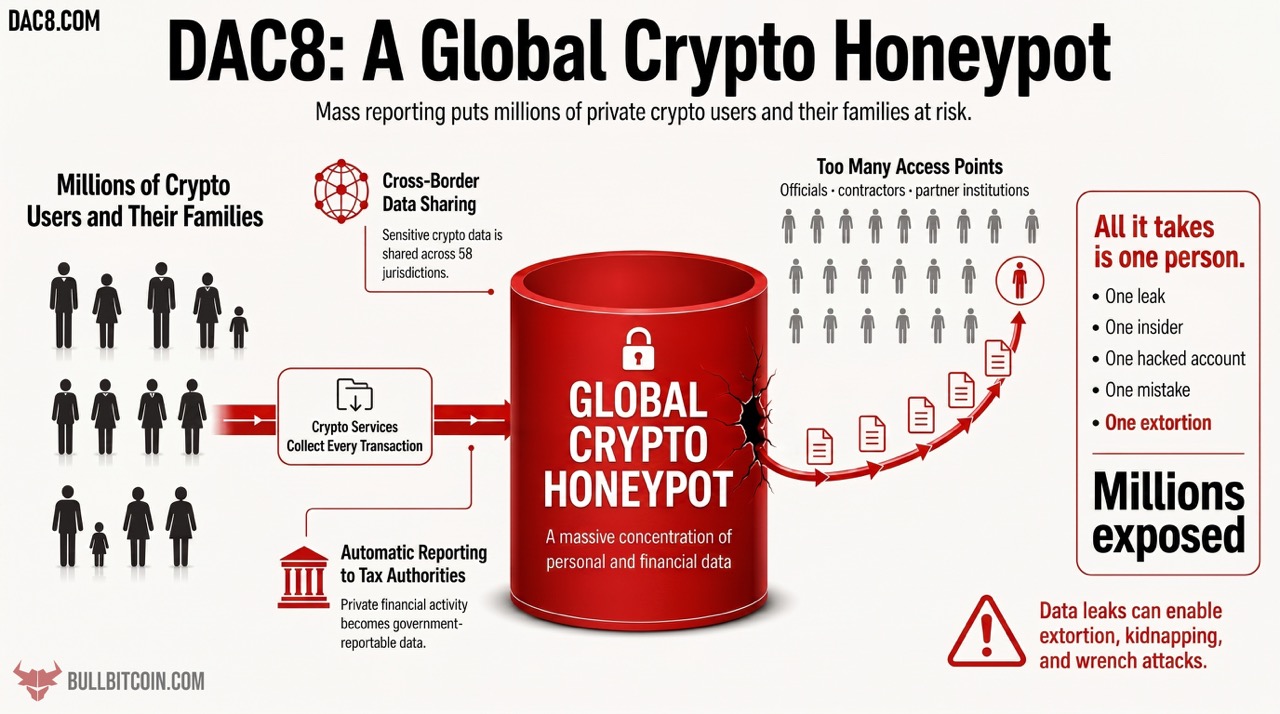
His criticism does not stop at a philosophical disagreement with the tax administration. It targets the practical architecture of the text. By linking civil identity, declared address, transaction history and sometimes the usage patterns of a platform, DAC8 would, according to Bull Bitcoin, help build a database of extreme sensitivity. In a universe like Bitcoin, where the native transparency of the blockchain already makes it possible to go very far back into a user’s activity once certain entry points have been identified, this concentration of information radically changes the level of risk.
Bull Bitcoin insists here on an element that most regulatory debates still treat as secondary. A compliance database is not only an administrative file. It is also a target. Previous data leaks in the crypto ecosystem have already shown that a file containing names, addresses and wealth or transaction-related information can become raw material for phishing, extortion, physical targeting or resale on criminal markets. From the moment platforms, subcontractors, national administrations and then several foreign tax administrations access fragments of this data, the exposure surface keeps widening.
“Given the current situation, if you give people the choice between using a MiCA-regulated exchange, with the risk that their data will be collected and transmitted under DAC8, or going through over-the-counter trades, DEXs or offshore platforms that escape this surveillance, most will naturally choose the second option. In other words, DAC8 creates an incentive to bypass MiCA-regulated platforms. Instead of strengthening the attractiveness of the European framework, this regulation risks pushing part of Europe’s residents toward less supervised solutions.”
Bull Bitcoin’s reasoning has a particular resonance in France, where kidnappings and attempted kidnappings targeting cryptocurrency holders have multiplied since 2025, making the country the champion of “cryptorapts”. In this context, Théo Mogenet considers that the debate on compliance can no longer be abstractly separated from the question of physical security. The issue is no longer only whether the state can collect more information, but whether it properly measures the concrete consequences of centralizing it.
This logic explains the deliberately harsh nature of some of Bull Bitcoin’s formulas. Francis Pouliot, the platform’s founder, speaks of "KYC - Know Your Customer" turning into "KYC - Kill Your Customer" , while Théo Mogenet essentially describes the risk of seeing a directory emerge that criminal networks could exploit once these databases inevitably leak. Behind the apparent excess of the formula, the idea being defended is more structured than a simple slogan. The more a regulation multiplies the preventive collection of sensitive data, the more it creates the very conditions for a future harm it nevertheless claims to avoid.
Bull Bitcoin also advances another criticism, more classic but important. According to the company, AML/KYC systems have never demonstrated effectiveness proportionate to the scale of the data they absorb. On dac8.com, Bull Bitcoin states that the comparable AML/KYC regime intercepts only 0.1% of criminal funds, for $136.5 billion in annual costs in Europe. The site also recalls that the European Commission recognizes that it cannot precisely quantify the additional revenues generated by the automatic exchange of information, and cites the European Court of Auditors, according to which, between 2015 and 2017, only 2% of the taxpayers covered by these exchanges were linked to a tax identification number in the audited countries.
In the case of DAC8, the automatic reporting obligation would therefore amount to generalizing intrusive collection without clear evidence that it can neutralize a significant, or even proportionate, share of financial crime or actually improve tax collection. Worse, Bull Bitcoin believes the text could produce the opposite effect of the one intended by pushing the most cautious users toward less visible, less cooperative or less European rails.
In addition, the authorities already have targeted tools to obtain information when an investigation justifies it, notably through the right of communication. In this logic, the data is requested because there is a reason, a procedure and oversight. DAC8 reverses this principle. The data is first sent up systematically, before any suspicion even exists. It is this shift from targeted access to a preventive stockpile that Bull Bitcoin considers disproportionate, dangerous and politically unacceptable.
📰 Read also - El Salvador, Bitcoin and Bukele: Audit of a Political Laboratory
By attacking DAC8, Bull Bitcoin is also testing the ecosystem’s capacity for resistance
The action brought against the French transposition decree should not be read only as an administrative dispute. In Théo Mogenet’s words, it also serves to ask a broader question to the entire sector. What is a European Bitcoin industry worth if, once it has entered the MiCA framework, it accepts every new requirement without discussion in the name of regulatory realism?
Bull Bitcoin explains that it filed a summary petition on February 24, 2026, before completing its action with a fuller brief. The choice to communicate later is not insignificant. According to Théo Mogenet, the company first wanted to secure its regulatory position in Europe before opening this fight head-on. Once MiCA had been obtained, Bull Bitcoin considered itself better placed to challenge DAC8 without being easily disqualified as a peripheral or irresponsible actor.
This sequence gives the action significant symbolic force. Bull Bitcoin can now tell the market that it played by the rules of the European framework, that it knows its constraints from the inside, and that this is precisely why it considers it necessary to raise its voice. The company therefore does not present itself as an external opponent of regulation, but as a regulated actor that believes regulation has crossed an unacceptable threshold.
Théo Mogenet also insists on the fact that Bull Bitcoin does not want to turn this battle into a soft coalition or a sector committee without a clear line. He indicates that a 2nd company is participating in the initiative, without wishing to make its identity public, but he rejects the idea of creating a broader lobby that would mechanically aggregate all actors. His concern is simple. As soon as too many divergent interests enter the room, energy shifts toward coordination, diplomacy and compromise, at the expense of action.
This choice of independence does not prevent Bull Bitcoin from wanting to set an example. On the contrary, Théo Mogenet explains that the company would be ready to help other companies that would like to launch similar actions in other European countries. The objective is therefore not to centralize the challenge under its own banner, but to open a breach and show that it is possible, even for a regulated actor, to refuse certain extensions of administrative power.
According to him, the conflict is not between Bull Bitcoin and the other platforms on the market. It is between Bitcoin and the traditional banking world.
“The subject is Bitcoin against fiat currencies, not Bull Bitcoin against Paymium, Relai, StackinSat or any other actor. The market is meant to become large enough in the coming years that we will not need to fight over market share. And above all, if we start giving in on this type of legislation, there is no longer even any reason to try. We would send European institutions the signal that they can adopt almost any measure to complicate Bitcoin adoption without meeting any real opposition. That would be capitulating before even fighting. That is absolutely not the objective. And if this approach also benefits our competitors, all the better. Because what benefits Bitcoin ultimately benefits all the companies building around Bitcoin, including ours.”
For Théo Mogenet, Bitcoin is not only meant to offer a new speculative asset or a new payment channel. It also carries, at least for part of its historical defenders, a logic of separation between money and state. If the companies that live from this ecosystem are unable to defend this minimal boundary when data collection becomes systematic, then they risk keeping only a domesticated version of Bitcoin, compatible with all the surveillance reflexes of the fiat system.
This is what makes the action against DAC8 something other than a simple legal standoff. Even if the procedure were to last 12 to 24 months, or even one day go up to the Court of Justice of the European Union, Bull Bitcoin already seems to be seeking another result. To bring about a public debate in which platforms, users and decision-makers no longer discuss only the cost of compliance, but the boundary between legitimate regulation, mass surveillance and the real endangerment of cryptocurrency holders.
From this angle, the action serves as much to win as to force everyone to take a position. Will the other actors follow, at the risk of irritating their regulators, or will they prefer to consider DAC8 the normal price to pay to remain in the European game? It is probably on this question, even more than on the dispute itself, that Bull Bitcoin is trying to move the lines.
Sources: Press release, Interview Théo Mogenet, DAC8.COM