

Bitcoin's base layer is deliberately conservative. That is not a flaw, it is the reason the system remains auditable, permissionless, and politically hard to capture. "A feature not a bug".
But that conservatism comes with a cost, the base chain is not designed to absorb every small, frequent, time-sensitive payment that a global monetary network would generate. If Bitcoin had to do everything on-chain, it would have to choose between 2 things that should not be confused with one another:
- final settlement, where security and verifiability matter most;
- day-to-day payments, where speed, convenience, and low cost matter most.
The deeper reason Bitcoin stays conservative is that every extra layer of raw throughput on the base chain has a long-term cost. Bigger blocks and heavier on-chain usage mean more data to download, more disk space to keep, more bandwidth to validate, and more work for the people who run full nodes. Over time, that tends to push validation toward better-funded operators and fewer independent participants, which weakens the decentralization that Bitcoin is supposed to protect.
This incompatibility between scalability and decentralization has been known for a long time. The limited bandwidth was one of the first criticisms Satoshi Nakamoto faced when he introduced Bitcoin.
Years later, Vitalik Buterin formalized this tension through the idea of the “blockchain trilemma,” explaining that a blockchain cannot maximize security, decentralization, and scalability at the same time, and must compromise on at least one of these properties. Ironically, Ethereum, the blockchain created by that same Vitalik, is now scalable, but at the cost of weaker decentralization and, arguably, a less robust security model.
In fact, every new capability added to the base protocol, or on top, can improve one use case while opening a new surface of attack: more consensus rules, more edge cases, more implementation complexity, and more room for bugs or adversarial behavior. Bitcoin’s conservatism is therefore not just philosophical. It is a security choice.
Lightning exists to solve that tension.
Instead of asking Bitcoin to become a fast retail payments network, Lightning moves the repetitive part of payments into payment channels. The on-chain footprint stays small. The user experience gets faster. Bitcoin remains the settlement layer that enforces ownership and finality when it matters.
That is why Lightning should not be read as a separate money system. It is a coordination layer. It is the part of the Bitcoin stack that lets many wallets, services, and adjacent protocols exchange value using a shared grammar, while still falling back on Bitcoin for settlement when something must be enforced publicly.
🪙 Is Bitcoin (BTC) Really a Currency?
That is the right way to read Lightning: not as a rival chain, and not as a cosmetic upgrade, but as a payment layer that lets Bitcoin do more without changing what Bitcoin is at the base.
What Is the Lightning Network?
Lightning is a second-layer payment protocol built on top of Bitcoin. The original Lightning paper frames the idea of a decentralized system of micropayment channels whose transfer of value happens off-chain, while the blockchain is used when channels need to be enforced or closed.
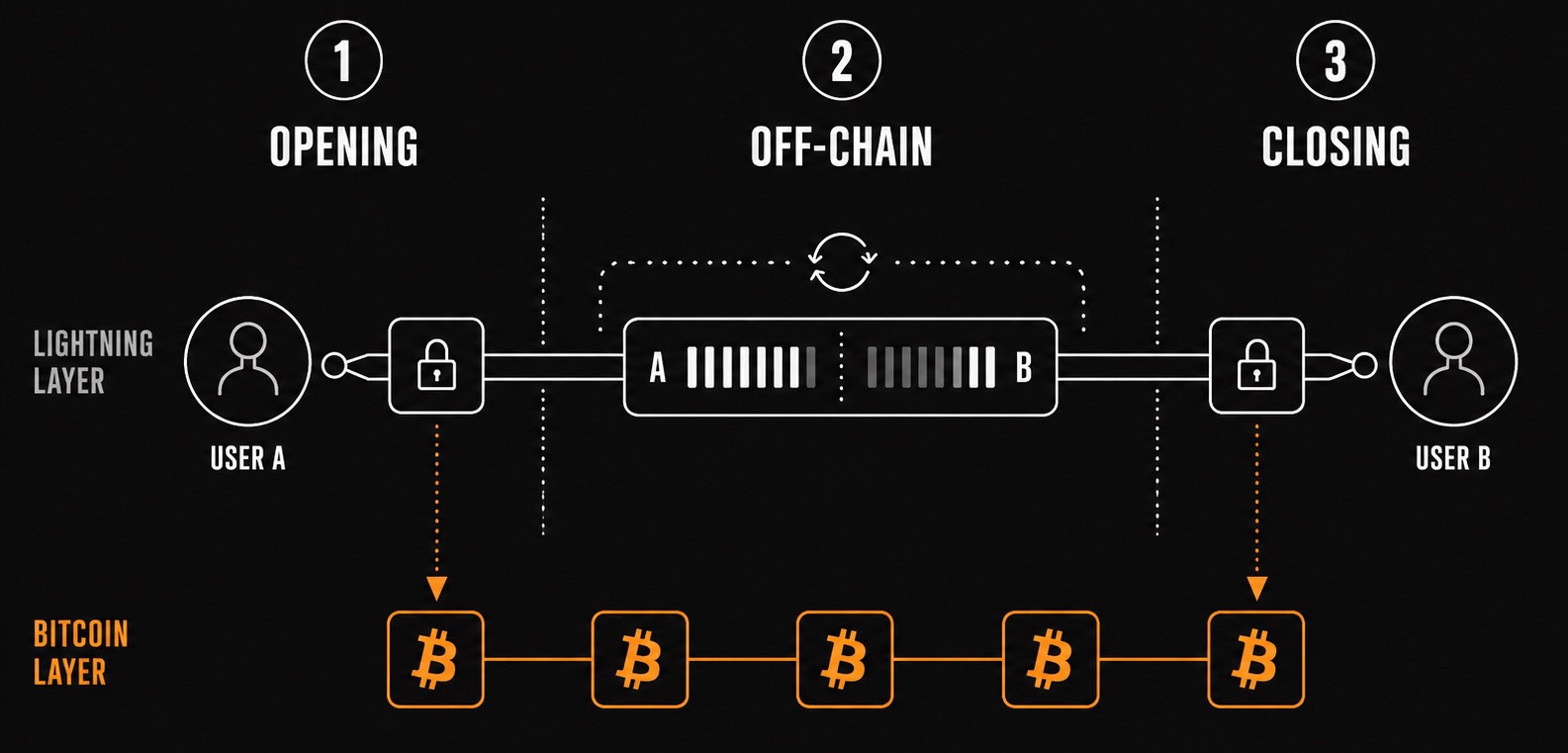
In practical terms, that means 2 people can lock funds into a channel, then update how those funds are split without writing every update to the blockchain.
Only the opening and closing states need on-chain settlement.
That matters because Bitcoin block space is kept scarce on purpose. If every small coffee, tip, in-game payment, or machine-to-machine transfer had to compete directly for on-chain inclusion, Bitcoin would become expensive and slow precisely where it should be useful.
Lightning is the attempt to keep Bitcoin conservative at the base layer and useful at the payment layer.
It also changes the shape of the problem. Bitcoin on-chain is a ledger of final state. Lightning is a system for negotiating intermediate states safely, cheaply, and repeatedly. That distinction is what makes Lightning valuable: it does not try to record every movement of value on the base chain. It tries to compress a long sequence of small interactions into a structure that Bitcoin can still secure.
Why Bitcoin Needs a Second Layer
The Lightning idea makes sense only if you accept Bitcoin's trade-off.
Bitcoin prioritizes decentralization, verifiability, and censorship resistance. That means the base layer cannot simply be made arbitrarily fast without increasing the burden on node operators and weakening the ability of ordinary users to verify the network themselves.
The original Lightning paper is explicit about that constraint: if every node had to know about every transaction globally, the system would struggle to cover large-scale commerce without sacrificing its core properties.
So Lightning is not trying to replace the base layer. It is trying to protect it.
The logic is simple, but the implications are deeper than they first appear:
- Bitcoin settles.
- Lightning transacts.
- On-chain Bitcoin remains the final arbiter.
That separation is what gives the stack its elegance. It also explains why Lightning can be useful even when users do not consciously “use Lightning” in their daily lives. They may simply want a wallet, a merchant checkout flow, a payment link, or a value-transfer primitive that feels immediate.
Furthermore, Lightning has now become a communication layer between Bitcoin L2 protocols and applications. It is one of the mechanisms that allows the broader stack to offer fast payments and interoperability without forcing Bitcoin itself to become a fast, mutable payments database.
How Lightning Works
1. Open a channel on-chain
2 participants create a funding transaction on the Bitcoin blockchain. That transaction locks funds into a shared channel.
At that point, the channel exists as a base-layer object, but the repeated updates do not need to hit the chain again and again. In other words, the chain establishes the legal and cryptographic boundary, while the channel becomes the working space where the 2 parties can move value back and forth.
2. Update balances off-chain
Once the channel is open, the 2 sides can exchange signed updates that change how the balance is distributed between them.
These updates are not broadcast to the entire network. They are bilateral, fast, and cheap. If the channel were closed at that moment, the latest valid state would determine the final split.
That is the core Lightning trick: use Bitcoin to secure the channel, then avoid using Bitcoin for every individual payment inside it.
This is also why Lightning requires discipline. A payment channel is not just a more convenient address. It is a state machine with time-based guarantees, revocation rules, and assumptions about how each participant behaves if the other side disappears or tries to cheat.
3. Route payments across the network
Lightning is not limited to direct channels.
If Alice does not have a direct channel with Bob, the payment can travel through intermediate nodes, provided each hop has enough capacity and the route is viable. This is where the network effect starts to matter: the more connected the graph is, the more useful the layer becomes.
The forwarding logic is governed by the Lightning specifications, known as the BOLTs. BOLT 4 covers onion routing, while other documents cover messaging, transactions, gossip, payment encoding, and newer offer formats.
That spec structure matters because Lightning is not a single feature. It is a protocol stack.
It is also why Lightning is increasingly useful as an interoperability layer. If 2 systems can both speak Lightning’s payment language, they do not need to be identical underneath. They only need a shared syntax for requests, routing, settlement constraints, and recovery paths.
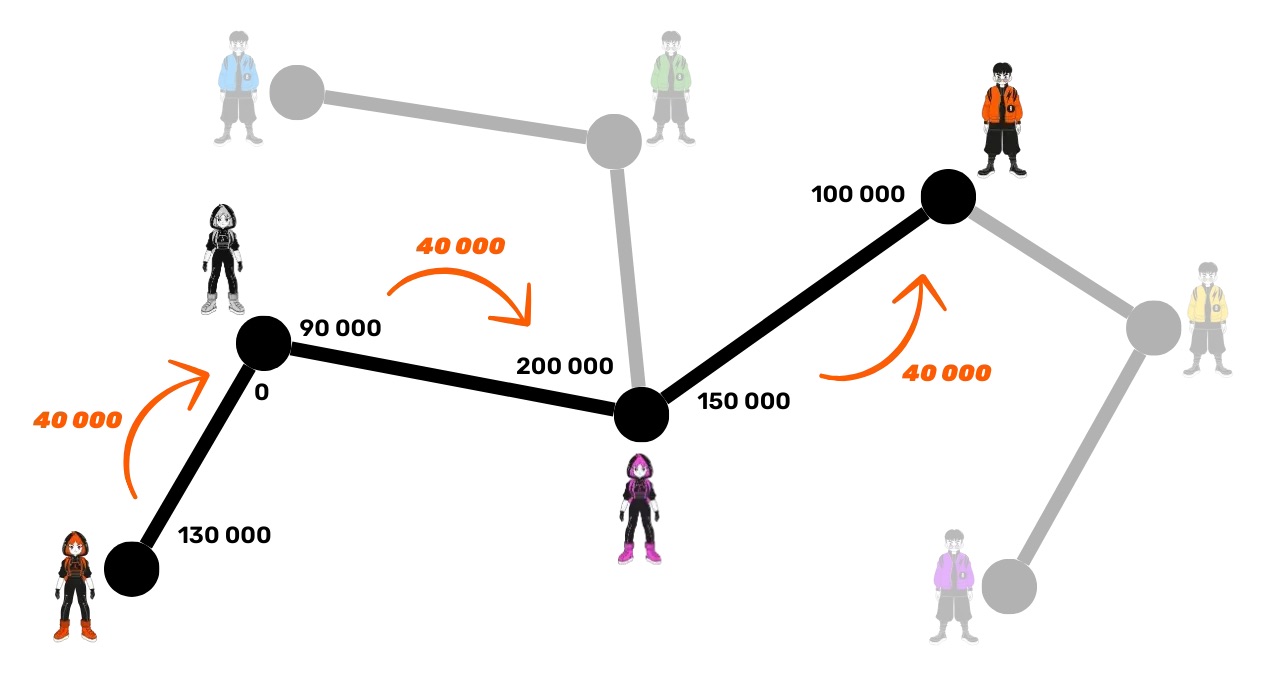
4. Use onion routing and conditional payments
Lightning payments are not forwarded as naked instructions from sender to receiver.
Instead, the protocol uses onion routing so that each intermediary only learns the previous hop and the next hop, not the entire route. Payments also rely on conditional mechanisms such as hash time-locked contracts, which make it possible to move funds safely across multiple hops without trusting every node in the path.
This is what gives Lightning both its privacy properties and its routing model.
It is also why Lightning is more than just "Bitcoin, but faster." It is a different payment architecture built on top of Bitcoin's settlement guarantees.
5. Settle on-chain when needed
If a channel needs to be closed cooperatively, both sides can settle the final state on-chain. If one side misbehaves or becomes unavailable, the protocol has on-chain enforcement paths to protect the honest participant.
That fallback is what makes Lightning credible. The off-chain layer is only safe because the base layer can still arbitrate.
The important point is that Lightning does not remove Bitcoin’s role as the final judge. It depends on Bitcoin being hard to rewrite, hard to censor, and expensive to attack. The layer-2 design only works if the base layer is more conservative than the layer above it.
What Lightning Does Well
Lightning is strongest when the payment problem is repetitive, small, or time-sensitive.
Fast, low-cost payments
Lightning removes the need to record every small transfer on-chain. That is why it can support near-instant payment experiences with very low fees compared with on-chain transactions during periods of congestion.
That is not just a technical improvement. It changes what kinds of commerce are possible. Payments that were previously too small to justify on-chain fees can become viable. A monetary network that can only settle large chunks of value is not enough to support everyday commerce. Lightning exists precisely to widen the practical range of Bitcoin use.
Better fit for microtransactions
Bitcoin on-chain works well for settlement and larger-value transfers. Lightning is better suited to use cases where the value per payment is small but the number of payments is high.
This is why Lightning keeps coming up in discussions about streaming payments, creator monetization, machine-to-machine payments, merchant checkout, and other flows where the payment itself should be almost invisible to the user.
A more natural UX for spending
The base layer is excellent for finality. Lightning is better for usage.
That distinction matters because a monetary network only becomes practical if users can do more than simply hold the asset. They need to send it, receive it, and do so without thinking about block confirmation every time.
A path toward softer user experiences
Lightning is also interesting because it can be hidden behind better UX layers.
A user may not want to think about channels, route finding, or liquidity management. In the future, wallets and higher-level protocols may abstract much of that complexity away. But that abstraction only works because Lightning exists underneath.
What Lightning Does Not Solve
Lightning is useful, but it is not magic.
Liquidity still matters
A route can exist on paper and still fail in practice if the right side of a channel does not have enough usable liquidity.
This is one of the biggest reasons Lightning remains operationally harder than ordinary payment apps. The protocol is fast, but the payment path still depends on where funds sit inside the channel graph.
The implication is subtle but important: capacity and usefulness are not the same thing. A network may show a large nominal balance, but if that balance is poorly positioned, the network may still be difficult to use for real payments.
Channels need maintenance
Users often need to open channels, close channels, rebalance, or rely on wallets and service layers that manage those steps for them.
That creates a trade-off: more control can mean more complexity.
It also means that Lightning works best when the surrounding ecosystem is healthy. Better wallets, better defaults, better routing information, better liquidity management, and better abstractions all matter. The protocol alone is not enough.
Privacy is improved, not perfect
Onion routing improves privacy, but it does not make Lightning transactions completely invisible.
When a payment is routed through Lightning, each intermediate node can verify and forward the packet, and it learns only what it needs to do that job: its predecessor, its successor, the forwarding amount, and the routing constraints attached to that hop. According to the BOLT 4 onion-routing specification, intermediate nodes cannot learn the full route, the route length, or their position inside the entire payment path.
That is a real privacy improvement compared with on-chain transactions, where the full transfer history is exposed on the public ledger.
But the improvement is partial. The sender and receiver still need wallet software, network access, and a set of routing assumptions. Metadata, channel topology, timing patterns, and wallet behavior can still leak information. A large node operator may also infer useful patterns from what passes through its own infrastructure.
The custody model matters just as much.
- In a custodial wallet such as classic Wallet of Satoshi, the operator controls the keys and therefore has a much broader view of the user’s balance and payment history.
- In a self-custodial wallet such as Phoenix, the provider does not hold the user’s keys, but the wallet can still rely on provider infrastructure for parts of the Lightning experience, so most metadata may be visible to the service even if it is not visible on the public network.
So the right way to describe Lightning privacy is not “private” or “not private.” It is more precise to say that Lightning reduces public exposure, but privacy still depends on the route, the wallet, the operator, and the way the payment is constructed.

Not every wallet is non-custodial
Some Lightning experiences are custodial. That is an implementation choice, not a requirement of the protocol.
This is an important distinction because the user experience can look similar while the custody model is completely different.
Lightning as a communication layer between Bitcoin networks
This is the part that matters most for the broader Bitcoin stack.
Lightning is not only a way to send sats. It is increasingly a shared language for moving value between different Bitcoin-adjacent systems.
In practice, a “language” here means three things:
- A way to request payment
- invoices, offers, and metadata tell the payer what to pay, to whom, and under what conditions;
- A way to move payment
- routing, onion packets, liquidity constraints, and HTLC-style conditions define how value travels safely through the network;
- A way to settle or fail safely
- the protocol has to answer what happens if a channel is uncooperative, a node disappears, or a path breaks halfway through.
That shared grammar is what makes Lightning useful beyond plain consumer payments.
A wallet, a merchant tool, a swap service, a sidechain bridge, or a higher-level Bitcoin protocol does not need to implement exactly the same business logic to benefit from Lightning. It just needs to agree on enough of the transport layer to communicate.
That is why Lightning is increasingly less about “the thing users open manually” and more about “the interop fabric below the user experience.”
This is also where our Bitcoin L2 map becomes useful. The map shows that Lightning is not an isolated island. It sits at the center of a layered stack where other systems try to route value, abstract custody, or add assets and functionality without asking Bitcoin’s base layer to do everything.
Seen from that angle, Lightning is the connective tissue of the stack, a common language for Layer 2 protocols such as Ark, Spark, or RGB; sidechains such as Liquid or Rootstock; rollups such as Citrea; and other applications such as (the real) e-cash.
Some layers use it directly. Others borrow its payment semantics. Others coexist with it while depending on Bitcoin for final settlement. But the common point is the same: Lightning provides a recognizable communication pattern for value transfer in the Bitcoin ecosystem.
That is why the layer matters even when end users never think about invoices, routes, or channel graphs. The protocol can disappear behind the interface, but the language still shapes what the interface can do.
Lightning, BOLT12, and the Evolving Spec
Lightning is not frozen in time.
The BOLTs repository shows how the specification keeps expanding across messaging, transport, routing, payment encoding, and offer encoding. That is a sign of a living protocol, not a finished product.
One practical consequence is that Lightning is moving beyond the older invoice-only model. Newer standards aim to make payment requests more flexible and more useful for real-world apps.
For readers, the key takeaway is simple: Lightning is already useful, but its best user-facing forms may still be ahead of us.
Where Lightning Fits in the Bitcoin Stack
Lightning does not sit alone.
It sits inside a layered Bitcoin architecture:
- the base layer handles settlement;
- Lightning handles payments;
- other layers and protocols explore different trade-offs around custody, privacy, assets, programmability, and UX.
That is why Lightning matters even when users eventually spend through other systems like Ark, Liquid, RGB, or other abstractions. Those protocols still need a payment rail, a settlement logic, or an interoperability story.
The useful way to think about this is not “which layer wins?” but “which layer does which job best?”
- Bitcoin base layer: ultimate settlement and verification.
- Lightning: frequent, small, time-sensitive payments and transport.
- Higher-level Bitcoin systems: more specialized trade-offs around UX, assets, privacy, or programmability.
That architecture is important because it protects Bitcoin from feature creep. The result is a cleaner separation of concerns, and that separation is one of the reasons Bitcoin can keep its core rules stable while still supporting experimentation above it.
Lightning is one of the most mature answers to that problem today.
Vulnerabilities, limits, and why they do not justify changing Bitcoin lightly
Lightning is not perfect, and pretending otherwise would weaken the article.
Because Bitcoin was not originally designed to support payment channels at scale, Lightning has exposed edge cases over the years. One example is the replacement cycling attack described by Antoine Riard. In simplified terms, the attack exploits the fragile interaction between channel state, unconfirmed transactions, and mempool behavior. It is a reminder that the security of Lightning does not come from magic; it comes from careful assumptions about how Bitcoin relays, confirms, and protects transactions.
That class of vulnerability matters, but it also has to be put in proportion.
- The attack is technically real, but operationally expensive.
- The known mitigations have been deployed in major Lightning implementations.
- The attack has not become a broad, obvious, mass-scale theft vector on mainnet.
In other words, the issue exists, but it remains bounded.
That is the key editorial point: Lightning does not need to be flawless for Bitcoin to remain strong. It only needs to be good enough that the known risks are manageable, observable, and more expensive to exploit than they are to defend against.
💡 What will happen if Bitcoin fails to become a currency?
This is also where the Bitcoin community’s conservatism matters. If the only way to eliminate every edge case in Lightning were to modify Bitcoin’s base rules materially, then the default answer would still be caution. Bitcoin’s core value proposition is not “feature accumulation at all costs.” It is stability, credibility, and a base layer that is hard to change without a very strong reason.
There are proposals and discussions that could make future Lightning designs more robust, including changes at the Bitcoin layer or transport layer. Some of those ideas may eventually become important. But the present reality is simpler: the known Lightning vulnerabilities are narrow enough that they do not justify turning Bitcoin into a moving target just to eliminate every last protocol tension above it.
The practical conclusion is not “ignore the vulnerabilities.” It is “keep improving the layer above while protecting the layer below.”

FAQ
Is Lightning custodial?
Not by definition. Lightning can be used in both custodial and non-custodial ways. The protocol itself is about payment channels and routing; custody depends on the wallet or service you choose.
Do I need a channel for every payment?
No. A payment can traverse the network through intermediate nodes, so you do not need a direct channel with every counterparty. But the network still depends on channels somewhere.
Is Lightning private?
It is more private than many naïve on-chain payment flows, especially because of onion routing. But it is not perfectly private, and users should not treat it as anonymity by default.
Is Lightning replacing Bitcoin on-chain?
No. Lightning relies on Bitcoin's base layer for enforcement and settlement. If anything, it makes the base layer more valuable by using it more selectively.
Why not just use on-chain Bitcoin?
For settlement, on-chain Bitcoin is excellent. For frequent, small, or time-sensitive payments, it can be too slow or too expensive. Lightning exists to fill that gap.
Conclusion
Lightning is not the whole story of Bitcoin, but it is one of the clearest examples of how Bitcoin scales without changing its core rules.
It keeps the base layer conservative and verifiable. It moves repetitive payments off-chain. It introduces routing, liquidity, and channel management as the price of speed. And it opens a path toward a Bitcoin payment experience that is much closer to what everyday users actually need.
More importantly, it has become a communication layer in the broader Bitcoin stack. It gives wallets, merchants, services, and higher-level protocols a shared way to exchange value without forcing everything back onto the base chain.
That is why Lightning still matters even when people argue about whether they will ever "use" it directly.
They may not open channels by hand.
They may not think about onion routing.
They may never manage liquidity themselves.
But if Bitcoin becomes a real payment network, Lightning will certainly be part of the stack.
And if that stack keeps growing, our Bitcoin L2 map is the best way to see how those pieces fit together.
Sources : Plan₿ Academy, Lightning white paper, WoS, Phoenix