Bitcoin's base layer is deliberately conservative. That is not a flaw. It is the reason the system remains auditable, permissionless, and difficult to capture. Every full node must be able to verify the same monetary rules, and every increase in raw throughput has a long-term cost in bandwidth, storage, and validation requirements.
But this conservatism creates a familiar tension. Bitcoin is excellent at final settlement, but it is not designed to record every small, frequent, time-sensitive payment directly on-chain. A global monetary network needs two different functions that should not be confused:
- final settlement, where security and verifiability matter most;
- everyday payments, where speed, convenience, and low cost matter most.
Most Bitcoin scaling proposals start from that tension, then choose a different compromise.
The Lightning Network moves payments into channels, allowing users to update balances off-chain while Bitcoin remains the court of final settlement. It is the most mature payment layer in the Bitcoin ecosystem, but it comes with operational complexity: channels, routing, inbound liquidity, backups, watchtowers, rebalancing, and liquidity management.
Liquid takes another route: a federated sidechain with faster settlement and asset issuance, but with a very different trust model. RGB and Taproot Assets explore client-side or Lightning-adjacent asset systems. Chaumian e-cash wallets simplify the payment experience even further, but usually at the cost of direct custody. Newer designs such as Spark, BitVM-based constructions, and other off-chain protocols continue to explore different ways to make Bitcoin more useful without changing the base layer too aggressively.
Ark belongs to this broader search for Bitcoin scalability. It was publicly introduced by Bitcoin developer Burak Keceli on the bitcoin-dev mailing list on May 22, 2023, as an alternative second-layer design focused especially on one of Lightning's hardest user-experience problems: receiving payments without first solving inbound liquidity.
The original intuition was simple but important. If Bitcoin payments require every user to understand channels and liquidity before they can receive money, the user experience will remain difficult. Ark tries to approach the problem from another direction: instead of making every user manage channels, it gives users virtual UTXOs that can move off-chain and be periodically anchored back to Bitcoin.
That is why Ark should not be read as a replacement for Lightning, or as a sidechain, or as a custodial wallet with a technical name. It is a different attempt to separate day-to-day payments from final settlement while preserving a path back to Bitcoin.
The key question is therefore not whether Ark “beats” Lightning. The better question is what trade-off Ark introduces: it can reduce channel complexity for users, but it shifts much of the burden to operators, liquidity, settlement cycles, wallet automation, and emergency exits.
What is Ark?
Ark is a Bitcoin scaling protocol designed to make bitcoin payments faster and easier to use without requiring every user to manage Lightning channels. Instead of giving each user a direct on-chain UTXO for every payment, Ark represents ownership through virtual UTXOs, or VTXOs. A VTXO is an off-chain claim on bitcoin that can be transferred quickly, but remains connected to Bitcoin through pre-signed transactions and exit paths.
🪙 Is Bitcoin (BTC) Really a Currency?
In normal use, Ark users interact with an operator, often called an Ark Service Provider (ASP). The operator coordinates payments, provides liquidity and groups many user updates into periodic settlement cycles known as rounds. This batching allows many off-chain transfers to be compressed into fewer on-chain transactions, reducing cost and improving speed.
Ark does not try to replace Bitcoin’s base layer, it remains the final settlement and dispute-resolution layer. The goal is to move frequent payments off-chain while preserving a way for users to recover their funds on-chain if the operator disappears or refuses to cooperate.
The result is a different scaling model from Lightning. Ark avoids some of Lightning’s user-facing complexity, especially channel management and inbound liquidity, but introduces its own trade-offs around operators, VTXO expiry, liquidity management and settlement timing.
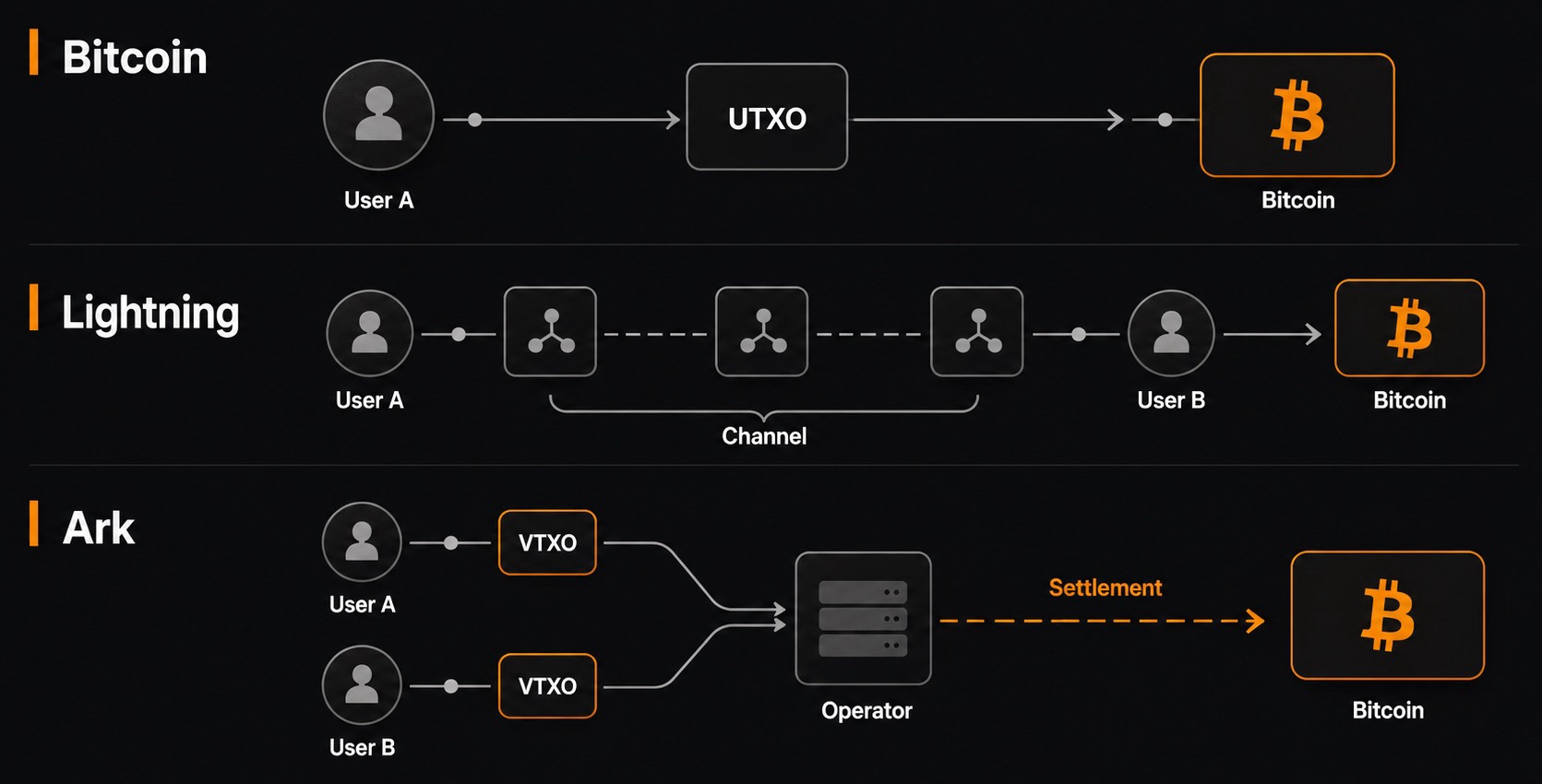
Why Bitcoin needs protocols like Ark
Bitcoin’s base layer is intentionally constrained. Blocks are limited, confirmation takes time, and fees rise when demand for block space increases. This is not an accident, it is part of the design that lets ordinary users verify the system and prevents Bitcoin nodes network from centralization.
But this design also means that Bitcoin cannot scale everyday payments simply by putting every transaction directly on-chain. A global payment network would generate far more activity than Bitcoin’s base layer can process without sacrificing decentralization.
Lightning addresses this by creating payment channels. 2 users lock bitcoin into a channel, then update balances off-chain. Payments can also be routed across several channels, which allows users who do not have a direct channel with each other to pay one another.
To receive on Lightning in a self-custodial way, a user generally needs inbound liquidity. To send reliably, wallets need routes with enough liquidity. Nodes must monitor channels, handle backups, manage fees, rebalance liquidity and avoid edge cases. Modern wallets hide much of this, but someone still has to manage it.
Ark starts from a different assumption: perhaps the average user should not have to think in channels at all. They should be able to receive and spend bitcoin from a wallet-like balance, while the infrastructure provider handles batching, liquidity and settlement in the background.
How Ark works: virtual UTXOs explained
To understand Ark, start with the UTXO model.
Bitcoin does not work like a bank account with a single balance, it works with UTXOs, or unspent transaction outputs. A wallet balance is usually the sum of several UTXOs controlled by the user’s keys. When the user spends bitcoin, they consume one or more UTXOs and create new ones.
Ark keeps this mental model, but moves part of it off-chain. A VTXO, or virtual UTXO, is a claim on bitcoin that behaves like a spendable unit inside Ark. It is not a normal Bitcoin output visible directly on-chain for each user. Instead, many users’ rights can be represented through a shared on-chain structure and a set of pre-signed transactions.
In a simplified version, the Ark operator and the user cooperate to create a structure where:
- the user can spend the VTXO inside Ark;
- the operator can help coordinate fast payments and batching;
- the user has a path to exit to Bitcoin if cooperation fails;
- the system can periodically renew or settle groups of VTXOs.
This is why the word “virtual” matters. A VTXO is not the same as holding a simple on-chain UTXO in your wallet. It is a conditional, off-chain representation of ownership. Its safety depends on transaction design, timing, available data, wallet behavior and the state of settlement.
This way, many VTXO movements can happen without immediately consuming Bitcoin block space. But the cost is that users now depend on a more complex protocol state than a normal on-chain transaction.
What are Ark rounds?
Ark uses periodic settlement cycles, usually called rounds, to aggregate activity and refresh the system.
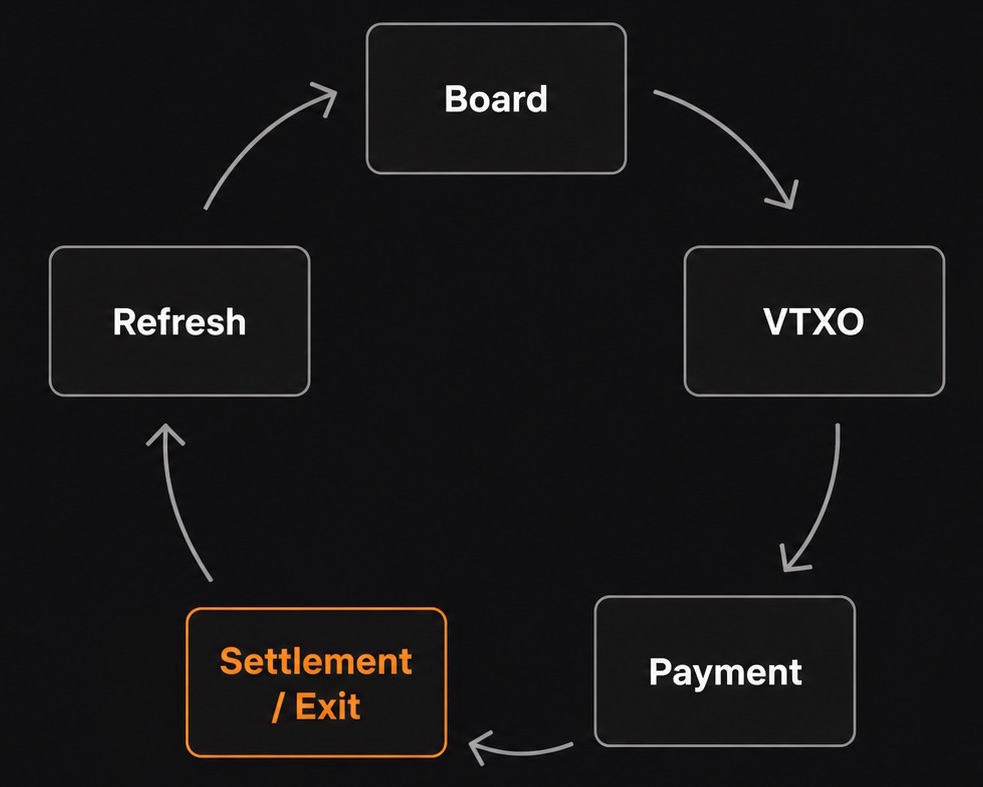
In a round, users can submit existing VTXOs, participate in a coordinated update and receive new VTXOs. The operator builds the relevant transaction structure and anchors the result to Bitcoin. Instead of every user making a separate on-chain transaction, many updates can be batched together.
Rounds serve several purposes:
First, they improve fee efficiency. If many users are grouped into a shared transaction structure, the on-chain cost can be spread across them.
Second, they renew VTXOs. Ark VTXOs are not meant to live forever without maintenance. They have timing assumptions and expiry conditions, wallets need to refresh them before those conditions give the operator definite access to the funds.
Third, rounds reduce risk from long chains of off-chain payments. A VTXO that has moved several times without settlement may become more expensive or more complex to exit, a refresh will bring it back to a cleaner state.
This distinction between payment experience and final settlement is essential. A user may see a payment as instant inside the wallet, but the strongest Bitcoin-level guarantee appears after the relevant commitment has been anchored on-chain and enough assumptions are satisfied.
This makes Ark feel familiar to anyone who understands payment systems more broadly: user experience can be fast, while final settlement happens in batches.
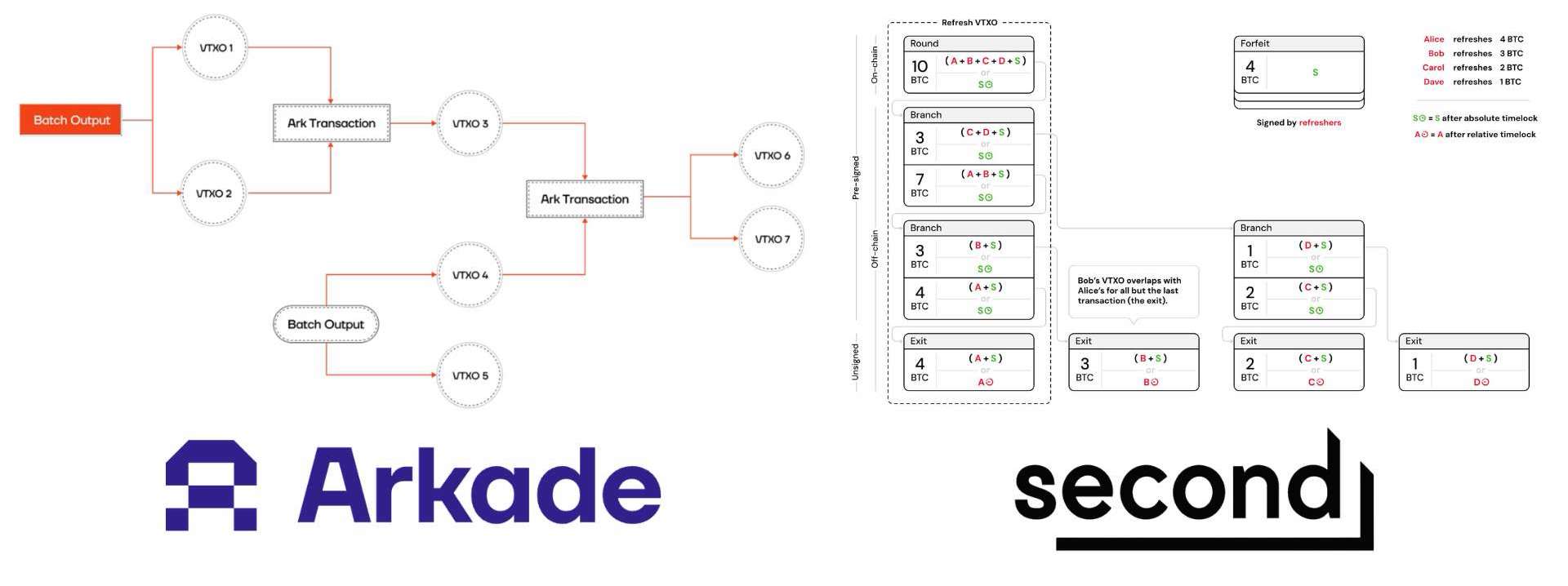
Ark, Second/Bark and Arkade: one protocol family, different approaches
A major source of confusion around Ark comes from vocabulary. “Ark”, “Bark”, “Second” and “Arkade” are sometimes used as if they described the same thing, while they actually point to different layers of the ecosystem.
Ark is the protocol family: a Bitcoin scaling model based on VTXOs, operators, off-chain transfers and on-chain exits. Second/Bark and Arkade build on that design space, but they do not optimize for the same product or the same kind of application.
Second/Bark: a more native payment-oriented Ark implementation
Second’s Bark implementation treats Ark first as a Bitcoin payment system. The user holds value as VTXOs and uses a wallet to send and receive payments, while the Ark server coordinates rounds, refreshes, boarding, offboarding, liquidity and Lightning connectivity.
In that model, the user does not need to run a Lightning node, open channels, find inbound liquidity or think about routing before receiving money. They can hold an Ark balance, pay Lightning invoices through a gateway, and receive Lightning payments that are converted into VTXOs.
That makes Bark the more payment-native interpretation of Ark. Lightning does not disappear, but it becomes an interoperability rail rather than the interface the user has to manage directly. This matters because internal Ark payments are easiest when users share the same server or compatible environment, while Lightning gives Ark wallets a way to reach the broader Bitcoin payment network.
Arkade: a programmable execution layer using swaps and a virtual mempool
Arkade takes the VTXO model in a broader direction. Instead of focusing mainly on wallet UX for bitcoin payments, it presents VTXOs as the basis for a programmable Bitcoin execution environment, with concepts such as a Virtual Mempool, an Arkade Operator, an Arkade Signer, intents, batch swaps, commitment transactions and Arkade Assets.
In Arkade, VTXOs are consumed and created by virtual Bitcoin-like transactions. These transactions can be preconfirmed off-chain, organized in a dependency graph, reused by other transactions, and later settled through batch swaps. The design is therefore closer to an operating system-like layer for Bitcoin-native applications than to a simple payment wallet.
This opens the door to trading, lending, programmable wallets, assets and potentially stablecoin-like instruments on Bitcoin, but it also adds more assumptions around execution infrastructure, signer security, asset indexing and settlement logic. Arkade should therefore not be described as “Bark with another brand”; it is a more programmable interpretation of the Ark/VTXO design space.
Ark and Lightning: differences and complementarity
Either Bark or Arkade should not be framed as a Lightning killer. A better way to understand it is as a different answer to the same scaling problem: how can Bitcoin support fast payments without forcing every transaction onto the base chain?
Lightning answers with payment channels. Users lock bitcoin into channels, update balances off-chain, and rely on a network of nodes to route payments across multiple hops. This makes Lightning powerful as an interoperable payment layer, but it also creates operational complexity around inbound liquidity, routing reliability, channel backups and rebalancing.
Ark answers with VTXOs. Users do not need a channel for each relationship; they hold virtual claims that an operator helps coordinate, refresh and eventually settle on Bitcoin. The complexity does not disappear, it moves from channel management to operator liquidity, settlement timing, VTXO expiry and exit design.
Second/Bark shows one form of complementarity: Ark can become the user-facing balance, while Lightning remains the rail used behind the scenes to pay the wider network. Arkade shows another one, where the VTXO model is extended into programmable execution, swaps, batch settlement and assets inside a virtual mempool.
In both cases, Ark is not a replacement for Bitcoin and not an obvious replacement for Lightning. It is another layer in the scaling stack, with a different trust profile and a different approach to user experience.
Is Ark self-custodial?
The honest answer depends on the state of the system, the implementation and what “self-custody” is supposed to mean in practice.
In a simplified way, Ark sits in a gray area between fully on-chain self-custody and a custodial payment service. Between rounds, the operator has a custodial-like role because users rely on it to coordinate liquidity and state transitions. After a commitment is settled on-chain, users regain a stronger self-custodial guarantee: they have a unilateral path to exit and recover their funds on Bitcoin, assuming they respect the required timing and have the necessary transaction data.
With a normal Bitcoin UTXO, the security model is relatively direct: you control the private key and can broadcast a transaction, even if you still depend on fees and network propagation. Ark adds more protocol state around that ownership. The normal path is collaborative, so the operator coordinates payments and rounds; if it disappears, censors transactions or behaves maliciously, users fall back on exit paths and pre-signed transactions.
That does not make Ark equivalent to a custodial exchange account, since a properly designed Ark system should prevent the operator from simply taking users’ funds. But it also does not make Ark identical to holding bitcoin directly on-chain.
The most accurate framing is temporal:
- before settlement, Ark can feel and behave more like an operator-mediated system;
- after a valid on-chain commitment, the user’s unilateral exit guarantees become stronger;
- if the user misses expiry windows or lacks the right data, those guarantees can weaken;
- if fees spike during a mass exit, small VTXOs may become economically hard to recover.
For mainstream users, this nuance will only matter if wallets expose it clearly. For serious users, it is the core of Ark’s security model.
The role of the Ark operator
The operator is the piece of infrastructure that makes Ark usable as a payment system rather than just a set of pre-signed transactions.
It coordinates rounds, provides or sources liquidity, helps construct transaction trees, processes off-chain transfers, supports boarding and offboarding, and may connect users to Lightning. In Arkade-like systems, the same broad role can extend to virtual transactions, batch swaps and application-level execution.
That role is powerful even when it is not supposed to be custodial in the traditional sense. If the operator is offline, users may be unable to make fast new payments. If its fee policy is expensive, the system becomes less attractive. If it sees too much metadata, privacy suffers. If it refuses to cooperate, users may need to exit on-chain rather than continue normally.
Ark’s central trade-off is therefore not the mere existence of an operator, but the consequences of depending on one. The important questions are whether users can survive operator failure without losing funds, whether exits remain affordable during stress, and whether competing operators can exist so that users are not trapped in a single environment.

What can Ark be used for?
The most obvious use case is simple bitcoin payments. A wallet built on Ark could let users receive funds without understanding inbound Lightning liquidity, pay Lightning invoices without running a Lightning node, and give merchants a payment flow with less operational overhead.
For users, the ideal experience would be straightforward: open a wallet, receive bitcoin, spend it quickly, and only think about on-chain Bitcoin when entering or leaving the system. For developers, Ark offers a different backend model, built around VTXOs, rounds and operator APIs rather than channel management.
Arkade expands the scope further. If VTXOs can represent not only bitcoin payment claims but also programmable assets, Ark-style systems may become infrastructure for trading, lending, stablecoins or other financial applications on Bitcoin.
That possibility needs careful framing. The more programmable the system becomes, the more users must distinguish between Bitcoin settlement, off-chain execution, operator guarantees and asset-specific rules. A bitcoin VTXO and a stablecoin-like asset on Arkade do not carry the same risk profile.
What are Ark's limitations and risks?
Ark’s main limitation is inseparable from its main strength: the operator. By moving complexity away from users, Ark concentrates it in infrastructure providers that need liquidity, technical competence, uptime, fee management and secure transaction logic. If they fail, users may still have exit paths, but the experience becomes slower, more expensive and more stressful.
Timing is another constraint. VTXOs have lifetimes, and they may need to be refreshed, renewed or settled before expiry. Wallets can automate this process, but automation does not remove the underlying requirement; if a user disappears for too long, loses data or fails to come online when needed, guarantees can degrade.
Emergency exits also consume Bitcoin block space. Under normal conditions that may be acceptable, but a mass exit during high-fee periods could make small balances uneconomic to recover.
Maturity is the final practical risk. Ark is young compared with Bitcoin and Lightning, its implementations are still evolving, its vocabulary is fragmented, and some designs remain closer to experimental infrastructure than to mass-market payment rails. This makes messaging especially important: “self-custodial payments without Lightning complexity” is a useful shorthand, but it can hide the real trade-offs if it is not immediately followed by the operator, expiry and exit assumptions.
Is Ark a Bitcoin Layer 2?
Ark is usually described as a Bitcoin Layer 2, and the label is broadly reasonable because activity moves off-chain while Bitcoin remains the final settlement and dispute-resolution layer.
Still, the category can be misleading if it makes Ark sound like every other system using the same label. Ark is not Lightning, because it does not organize payments around user-managed channels and network routing. It is not Liquid, because it is not a federated sidechain with its own ledger and block production. It is not an Ethereum-style rollup like Citrea either, because it does not post a global execution state to Bitcoin in the same way rollups post data and proofs to another chain.
Ark is closer to an off-chain UTXO coordination protocol. Its core idea is to virtualize Bitcoin ownership, coordinate transfers off-chain, and preserve a path back to Bitcoin when needed. The “Layer 2” label is acceptable, but the mechanism matters more than the category.
Ark's place in the Bitcoin scaling stack
Bitcoin scaling will probably not be solved by one layer. The base chain provides monetary rules, censorship resistance and final settlement; Lightning provides instant payments through channels and routing; Liquid offers a federated sidechain model for certain exchange, trading and asset workflows; Ark introduces VTXOs, operators, batching, exits and a payment model that can hide much of the complexity from users.
Arkade pushes this VTXO model toward programmable execution and assets, while other systems such as RGB, Spark or BitVM-based constructions explore different parts of the same design space.
This modular view is more realistic than asking which one “wins”. Bitcoin’s base layer is too scarce to host everything directly, Lightning is too specialized to solve every UX problem, sidechains introduce their own trust models, and Ark adds another possible compromise: simpler payments through operator-coordinated virtual UTXOs.
If Ark works well, it could become one of the layers that makes Bitcoin feel less like a settlement network and more like everyday money. If it fails, the reasons will probably be practical rather than philosophical: poor liquidity, confusing wallets, expensive exits, immature implementations, or users misunderstanding what kind of custody guarantee they actually have.
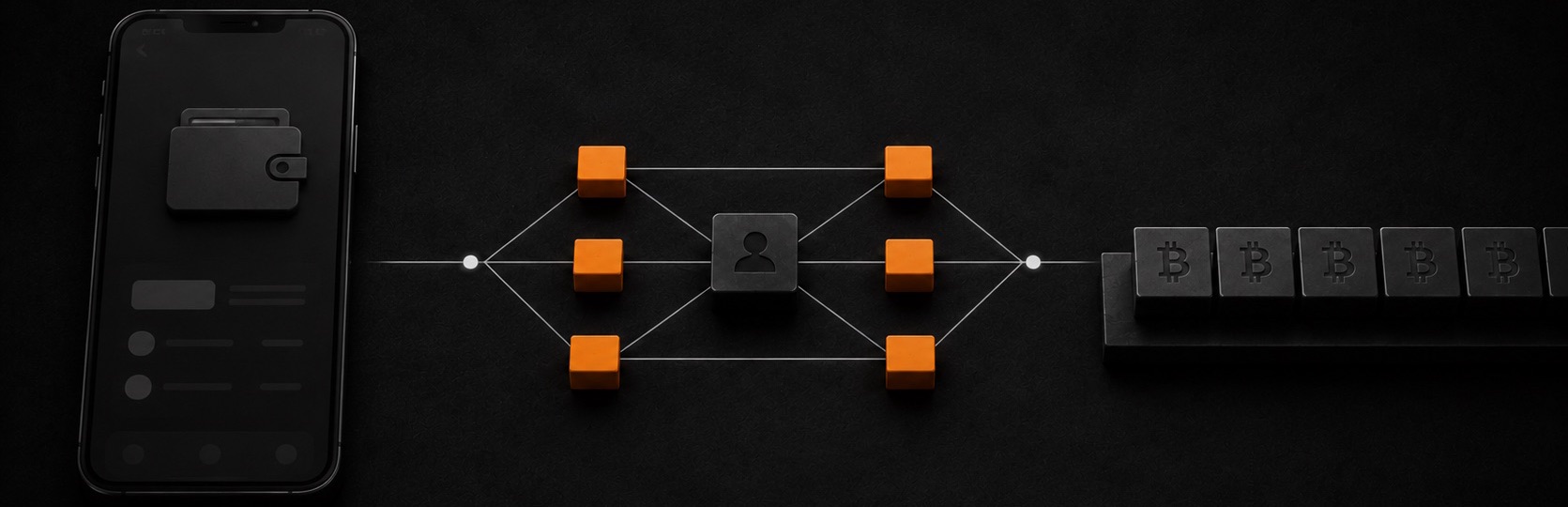
Conclusion: why Ark matters
Ark matters because it asks a useful question: can Bitcoin payments become easier without forcing every user to understand Lightning channels?
Its answer is technically ambitious. Virtual UTXOs, rounds, operators and exit paths create a model where users can transact quickly while Bitcoin remains the final arbiter. This could make self-custodial or semi-self-custodial payment wallets more usable, especially for people who do not want to manage liquidity.
The promise still needs to be evaluated with discipline. Ark does not eliminate trust assumptions, make on-chain fees irrelevant, or give users the exact same security model as a simple Bitcoin UTXO at every moment. Its strongest version is not “Bitcoin without complexity”, but Bitcoin with complexity moved from users and channels to operators, VTXOs, settlement cycles and wallet automation.
That may be a good trade-off, and for many users it may even be the trade-off that makes Bitcoin payments feel normal. But Ark’s success will depend less on the elegance of the idea than on implementation quality: Second/Bark for payment-native usage, Arkade for programmable execution, and future wallets that can explain these guarantees without hiding the uncomfortable parts.
Ark is not the missing piece by itself; it is one of the more interesting pieces in Bitcoin’s still unfinished scaling puzzle.
💡 What will happen if Bitcoin fails to become a currency?
FAQ
Is Ark the same as Lightning?
No. Lightning uses payment channels and routing. Ark uses virtual UTXOs coordinated by an operator and periodically settled or refreshed on Bitcoin. Both aim to scale Bitcoin payments, but they use different mechanisms.
Does Ark require opening payment channels?
No. One of Ark’s main advantages is that users do not need to open and manage Lightning channels directly. Ark replaces that user-facing channel model with VTXOs and operator-coordinated settlement.
Is Ark custodial?
Ark is not simply custodial or non-custodial. Between rounds, the operator has a custodial-like role because users depend on it for coordination and liquidity. After a commitment is settled on-chain, users should have stronger unilateral exit guarantees, assuming the implementation works correctly and users respect timing requirements.
What is a VTXO?
A VTXO, or virtual UTXO, is an off-chain representation of a claim on bitcoin. It can be transferred inside Ark, but remains connected to Bitcoin through pre-signed transactions and exit mechanisms.
What happens if the Ark operator disappears?
Fast payments stop, but users should be able to use emergency exit paths for properly settled VTXOs. The practical result depends on the state of the VTXO, expiry windows, available transaction data and on-chain fees.
What is the difference between Ark, Bark and Arkade?
Ark is the general protocol family based on VTXOs. Bark is Second’s payment-oriented Ark implementation. Arkade is a broader programmable execution layer using VTXOs, a virtual mempool, batch swaps and asset logic.
Can Ark support assets or stablecoins?
Basic Ark is mainly about bitcoin payments. Arkade extends the VTXO model toward programmable assets, which could support stablecoin-like use cases. Those assets introduce additional trust, indexing and issuer-specific risks beyond bitcoin itself.
Is Ark ready for mainstream Bitcoin payments?
Ark is promising, but still young. Its readiness depends on implementation maturity, wallet quality, liquidity, operator competition, fee behavior and the clarity of its custody guarantees.